Access to Care Project: From Treatment to Survivorship


About the Project
Most AYAs are diagnosed and/or treated in community cancer centers with services geared towards older adults. With unique concerns and issues faced by AYAs, many needs are overlooked in their care, including, but not limited to, discussions around fertility preservation, sexual health, relationships, and education or career interruption.
The Access to Care Initiative seeks to understand where, along the continuum of care, gaps appear for AYAs and then identify what patients and providers need to better address these gaps and better serve patients. Through a series of focus groups, discussions, and surveys, with providers and patients, Stupid Cancer will pinpoint specific challenges providers face in addressing the aforementioned challenges. With community input, we will develop tools to further support discussions and interactions between providers and AYA patients with the goal of improving the patient experience.
include goals here.
—
The Problem
AYAs Often Receive Inadequate Care
Stupid Cancer, a 501(c)(3) nonprofit founded in 2007, was established to address the lack of support for adolescent and young adult (AYA) cancer patients ages 15–39. Although progress has been made through the creation of AYA programs at cancer centers and the expansion of nonprofit services, significant gaps in care persist—largely due to limited healthcare provider training on AYA-specific issues such as fertility, relationships, career disruption, and financial strain.
To help close these gaps, Stupid Cancer partnered with professional associations serving cancer patients to better understand the AYA experience through the lens of provider interactions. Through a series of discussions, focus groups, and surveys of both providers and patients, the project identified where gaps in care occur along the continuum of treatment. With continued community input, Stupid Cancer is developing practical tools to strengthen communication and collaboration between providers and AYA patients—ultimately improving the quality of the patient experience.
31%
of providers reported a dedicated AYA program / staff at their institution
62%
of AYA cancer patients reported they weren’t given any AYA-specific resources
89%
of AYA cancer patients never discussed end of life care with their providers
Access to Care Initiative
Webinar & Discussion
In this informative webinar from April 2026, Stupid Cancer shared our research findings and how we’re leveraging this important data to improve cancer care for AYAs. This conversation also featured AYA survivor panelists to share their reactions and experiences.
Findings Presented at
American Psychosocial Oncology Society
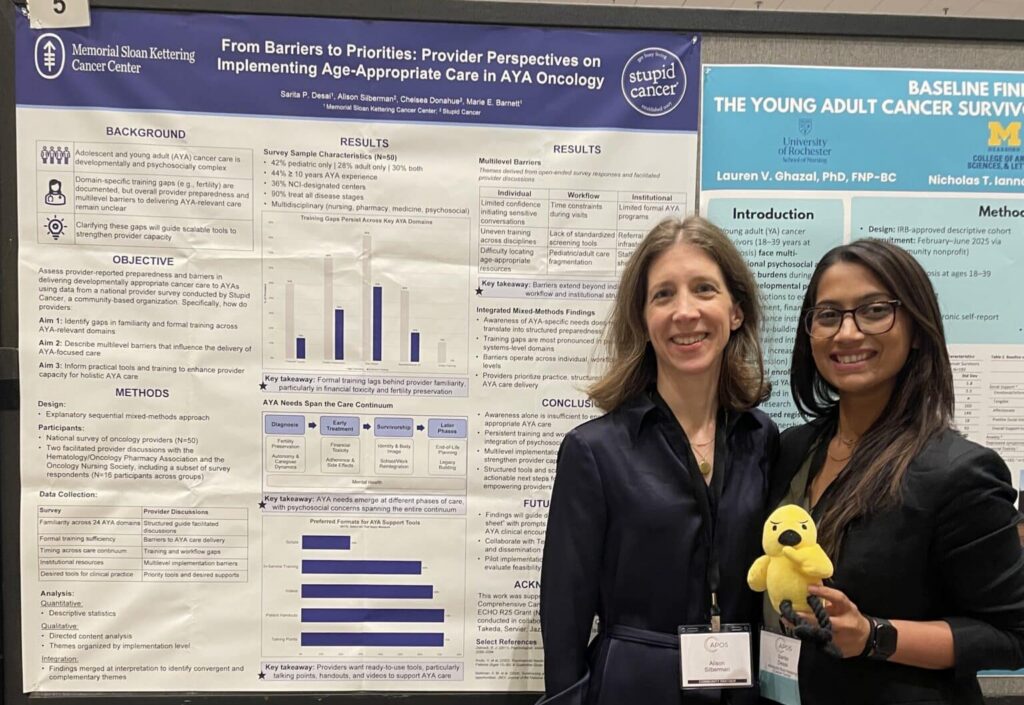
Stupid Cancer joined our partners Memorial Sloan Kettering Cancer Center to present findings from the Access to Care project on provider perspectives on implementing age-appropriate care in AYA oncology at the recent American Psychosocial Oncology Society conference.
Methods
Provider-facing surveys [n=50] were sent via email with responses collected June 2023 – April 2024. A virtual focus group [n=18] took place June 2023. Surveys were also distributed via email to AYA patients [n=67] to examine discrepancies between patient and provider experiences. Providers were queried about their level of training & familiarity with 24 critical topics for AYAs, such as: fertility preservation, dating & sex; end of life care, mental health, school/career, and financial toxicity.
Key Takeaways

Overall, providers feel comfortable discussing these topics; but training is inconsistent.
Most providers reported feeling comfortable discussing the critical issues that shape the AYA cancer experience, particularly those directly tied to treatment. Side effects (84%), palliative care (78%), and shared decision-making (72%) were the areas of strongest familiarity. These findings suggest that providers are generally confident in addressing the immediate and clinical aspects of care. However, confidence does not always reflect formal preparation. Training on these issues varied widely, and when it came to mental health—a top concern for AYAs—only half of providers rated their training as sufficient or expert-level, while 10% reported no training at all.
This inconsistency highlights a systemic gap: while providers may be addressing these conversations, the lack of structured, comprehensive training means they may not be equipped to do so effectively. Without standardized education, providers are left to rely on personal experience or institutional resources, which can vary significantly across care settings.
Both providers and patients expressed dissatisfaction with the availability of AYA resources.
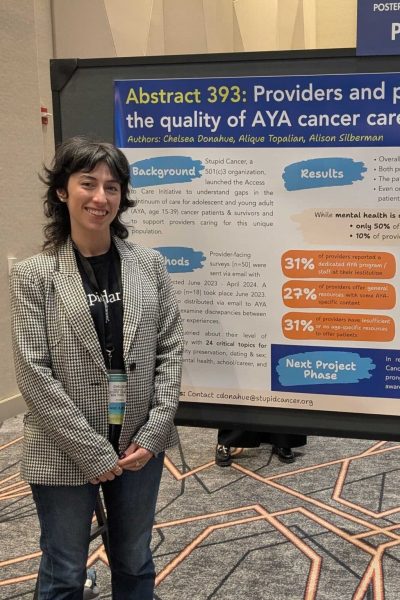
A major finding across both provider and patient responses was dissatisfaction with the availability of dedicated AYA resources. Only 31% of providers reported having a dedicated AYA program or staff at their institution—widely regarded as the gold standard of care. Another 27% offered general cancer resources with some AYA-specific content, while 31% acknowledged they had insufficient or no age-specific resources to provide. Focus groups underscored that patients treated at smaller community hospitals often faced even greater barriers to supportive care, particularly in accessing mental health services, compared to those at larger academic institutions.
Patients echoed these concerns, with 62% reporting that they were not given resources or connected to support groups during their care. Those who did receive resources often had to ask for them, and typically were directed to outside nonprofits or specific support programs, rather than being connected to institutional offerings. One patient summarized this frustration, saying, “I wish resources would have been provided from the beginning rather than me having to ask.”
The patient-facing survey revealed significant discrepancies from provider reports, with large gaps even in areas where providers rated themselves highly familiar.
A major theme across the findings was the disconnect between what providers said they discussed and what patients remembered or found meaningful. Providers largely reported addressing key issues such as fertility preservation, mental health, and community resources at diagnosis, but patients overwhelmingly indicated that these conversations either did not happen or left them dissatisfied. For instance, 89% of patients said end-of-life care and parenting with cancer were never discussed, while large majorities also pointed to gaps around survivor’s guilt, dating and sex, and palliative care.
This discrepancy persisted even in areas where providers rated themselves most familiar and comfortable. While 84% of providers reported confidence in discussing side effects, only 51% of patients were satisfied with how those side effects were explained. Similarly, although 70% of providers said they addressed fertility preservation at diagnosis, only 19% of patients reported being very satisfied with the information they received, and 16% said the topic was never raised at all. These findings suggest that provider comfort does not necessarily translate into patient understanding or satisfaction, and that timing, clarity, and reinforcement of information are critical to bridging this gap.
Mental health is one of the top concerns reported by AYA survivors.
Mental health emerged as a particularly urgent issue in both provider and patient findings. Half of providers acknowledged their training in this area was insufficient, and 10% reported receiving no training at all—despite the fact that they often indicated discussing mental health at diagnosis. From the patient perspective, dissatisfaction was even clearer: mental health consistently ranks as one of the most pressing concerns for AYA survivors, yet many reported limited or unsatisfactory conversations with their providers and few available resources. Without stronger provider training and institutional support, mental health needs are likely to remain unmet, leaving AYA patients especially vulnerable during and after treatment.
Professional Partners include:

ONS, the Oncology Nursing Society, represents thousands of nurses committed to excellence in oncology care. ONS supports its members through evidence-based educational initiatives and a focus on the improving the quality of life for patients with cancer and their families. As nurses are on the front line of patient care, ONS is a great partner in promoting resources and education to this unique population.

APOS, the American Psychosocial Oncology Society, works to advance science and the practice of psychosocial oncology. Many of the challenges AYAs face are psychosocial in nature such as career and education disruption, social emotional relationship, and sexual health, to name a few. Working together with this professional group will help reach a critical element of the AYA care team.

AOSW, the Association of Oncology Social Work, is an international nonprofit organization dedicated to the enhancement of psychosocial services to people with cancer and their families. Social Workers are a critical element on the AYA care team and can provide unique insight in the experiences of patients and help identify resources to support their work.

HOPA, the Hematology Oncology Pharmacy Association, is a professional association supporting oncology pharmacy practitioners through education, networking and the advancement of professional opportunities to optimize care for oncology patients.

ASCO, the American Society of Clinical Oncology, is a membership organization serving nearly 45,00 oncology professionals. ASCO’s mission is to conquer cancer through research, education, and promotion of the highest quality, equitable patient care.
APHON, the Association of Pediatric Hermatology/Oncology Nurses, is a professional organization for pediatric hematology/oncology nurses and healthcare professionals. Its members are dedicated to promoting optimal nursing care for children, adolescents, and young adults with cancer and blood disorders, and their families.
Initiative Goals
This project seeks to understand where, along the continuum of care, gaps appear and then identify what patients and providers need to better address these gaps and better serve patients. Through a series of focus groups, discussions, and surveys, with providers and patients, Stupid Cancer will pin point specific challenges providers face in addressing the aforementioned challenges. With community input, we will develop tools to further support discussions and interactions between providers and AYA patients with the goal of improving the patient experience.
We plan on achieving our goals by:
- Characterizing the healthcare experience for AYAs with cancer
- Developing informational resources to help inform providers of the unique challenges of AYAs and opportunities to address them.
- Providing AYA patients with the tools to advocate for themselves in the care setting
- Curating and raising awareness for resources devoted to the AYA patient population with particular focus on tools to support marginalized communities.

If you're a healthcare provider, your participation will help us better serve the AYA community leading to improved outcomes for those facing cancer and those who care for them.
Special thanks to our sponsors for helping make this project possible.


Sponsored by Takeda Oncology & AstraZeneca