
By Ashlee Cramer, Caregiver
My name is Ashlee, AKA caregiver extraordinaire. Sort of. I was a dancer; yep, on Broadway! Then a mom. Then an early childhood educator. Yet, here I am, now in the process of writing a book about caregiving; not singing or dancing or playing maracas.

December 12th, 2014 was the first time my world came to a halt because of cancer. My husband was diagnosed with Diffuse Large B Cell Lymphoma. It was a shock. But on the bright side, the prognosis was favorable. It was a “treatable cancer.” Some people call it a “good” cancer. Those are the people who have not been on this side of cancer. Cancer muggles. Because FYI, there are no good cancers.
My husband was given a standard chemo protocol and it seemed very clear cut, dry, straightforward, and spot-on. In the beginning I posed a few, probably obvious, definitely dumb, questions which were met by the oncologist with a cool smile and an undercurrent of, “be quiet, annoying wife of my patient”. So I shut my mouth. Maybe I imagined it, maybe not. Maybe the doctor was just having a bad day. Maybe a good day. He did smile after all. We were new to this, but he seemed smart, with the expert credentials to match. I had never been through cancer with someone close to me before, and just the word itself, CANCER, felt like a kind of sentence. Death or prison, I was not yet sure.
It was all so unfamiliar; the hospital, the chemos, the cancer terminology. But we wiped away our tears, lifted our chins, and put our trust in the doctor. We did exactly what we were told. And it worked. Patrice went into remission right on schedule. Remember, he had the “good” cancer.

He was at home, in hospice, with our three children, and me, his wife, holding him, tears rolling down all 4 sets of cheeks. We told him how much we loved him as he took his last breath. It was heartbreaking and tragic, and please do not take this the wrong way, still somehow beautiful. He died peacefully, without visible pain, and I thanked God he was at home, surrounded by love and not in a sterile hospital room.
At the time our children were 12 years old (Jennifer), 14 years old (Michael), and 16 years old (Steven). People were kind. Too kind. They told me I was strong. They told me I was brave. I felt like a fake. You know, imposter syndrome. I was not strong. I was not brave. My insides were broken into a million pieces. I felt guilt for many reasons. I did not save him. I did not fix him. Sometimes I did not love him enough. Sometimes I resented his cancer. I often resented his lack of fight. I definitely resented him for dying and leaving me alone. I did not choose for him to get cancer. I did not choose to be his caregiver. I did not choose to be a widow. I wanted what everyone wants; happily, ever after. The children and I cried a lot. But we smiled too.

I felt blessed to be so close to my kids. We hung out together. They didn’t really have those terrible teenage years. Patrice’s death gave us that gift. I worked a bit too much, to support us as a single mom, but we played a lot too. I did not forget Patrice, but the red, raw, gashes in my heart slowly turned to scars.
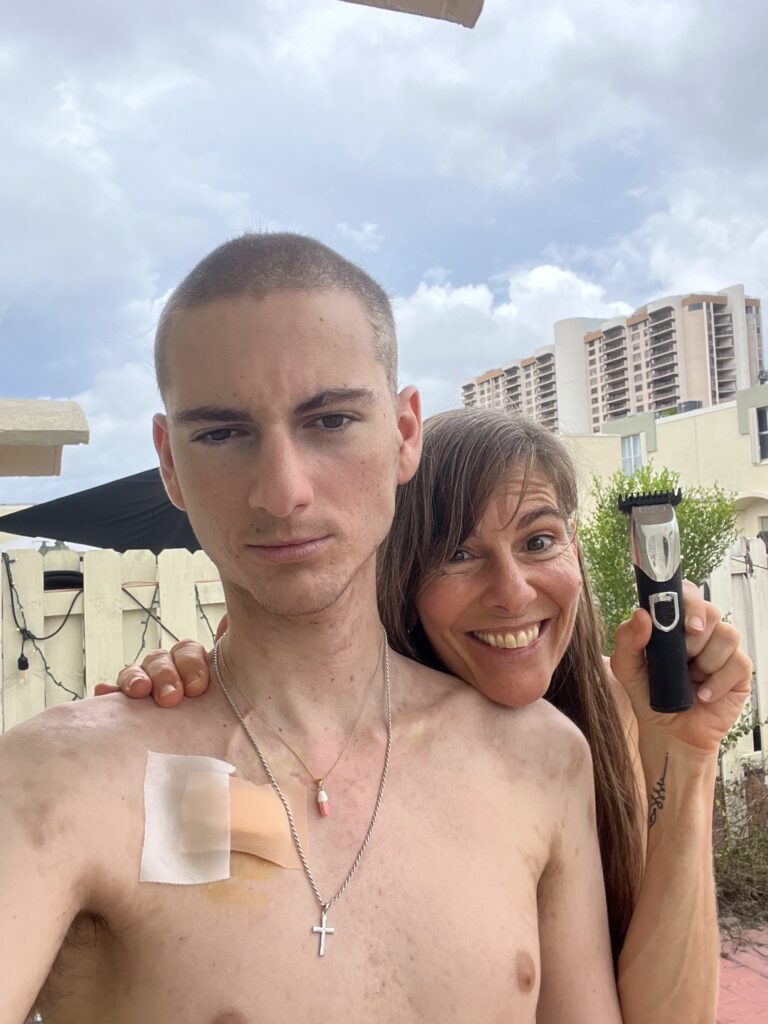 Until July of 2020, and my middle son Michael, now 19 years old, was feeling tired. He had night sweats and fevers. I thought he was anemic. I was a vegan mom after all. I felt guilty. Maybe I was not giving my athletic, teenage son enough red meat? He did a blood test which led to a bone marrow biopsy which led to the diagnosis of a completely unrelated-to-my-husband’s- disease, not-even-genetic, blood cancer: Hepatosplenic T-Cell Lymphoma. Never heard of it? Neither had most of the doctors. It was rare and aggressive. Stage 4.
In that instant, our lives changed again. The world stopped and the sun did not come up. Or at least I did not see it. And my role as caregiver shifted. Not caregiver to a grown adult man, a man who was perhaps too young to die but who had lived a semi-full life. Patrice had experienced a career. He had fallen in love and gotten married. He knew what it was like to be a father. But this time I was caregiver to a child. My child. A teenager. Not quite fully developed. A freshman in college. A kid with nothing ahead of him but time. Until that day.
I have spent the last 4 years as Michael’s full time caregiver. Without hesitation I gave up my career, my stability, and the future I thought I saw in front of me, to be by his side 24/7. When my husband was sick, I continued working. How else would we pay the bills? I took care of the Kids; kept them busy and out of his hair. Looking back, I wonder if I did not do enough for Patrice. Maybe I should have done more; spent less time supporting the family and more time supporting him. But that is hindsight. With Michael, it was a no-brainer. I was with him every moment of every day. I still am. Caregiving became the focus of my life. It is still the focus of my life. Hence, the book I am writing, this story, this “expert” guide from someone who has made all the mistakes.
I feel driven and compelled to share the lessons, the love, the support, and the ways of coping, that I have learned as a caregiver. From both experiences. I have been through ups and downs and all arounds, but maybe my experiences, my own trials and tribulations, my “aha” moments and moments of frustration, my ways of coping successfully and not so successfully, might help someone else. Maybe you, the one reading this. Cancer can be such a lonely place. The isolation. The feelings of not being able to function as you did before. Like ever. The loss of your previous life. The very emotional state of knowing people you used to connect with so easily, can no longer understand you, through no fault of their own.

There are many books out there and many resources for cancer caregivers. My book is intended to be little bit of wisdom. It is less focused on taking notes or how to contact insurance companies, and more about YOU. How you can take care of your loved one and also take care of your soul. Can you? I am still not sure. Every caregiver deals with caring for their loved one a little differently, with their own panache. We think that medicine is a science. Or maybe that is just me. I believed it was a scientific field that dealt with facts, questions, answers. But medicine has far too many variables. Everybody is different and every body is different. What may work for one cancer patient may not work for another. It is like that for the caregivers too. But I believe we have enough common threads that this advice can be of a tiny bit of service to you. Or at least justify the roller coaster of emotions that you are riding. I hope that what I have written here can inspire you to find comfort in your own unique journey as a caregiver. Unique, but still connected to all the other caregivers out there. Like me.